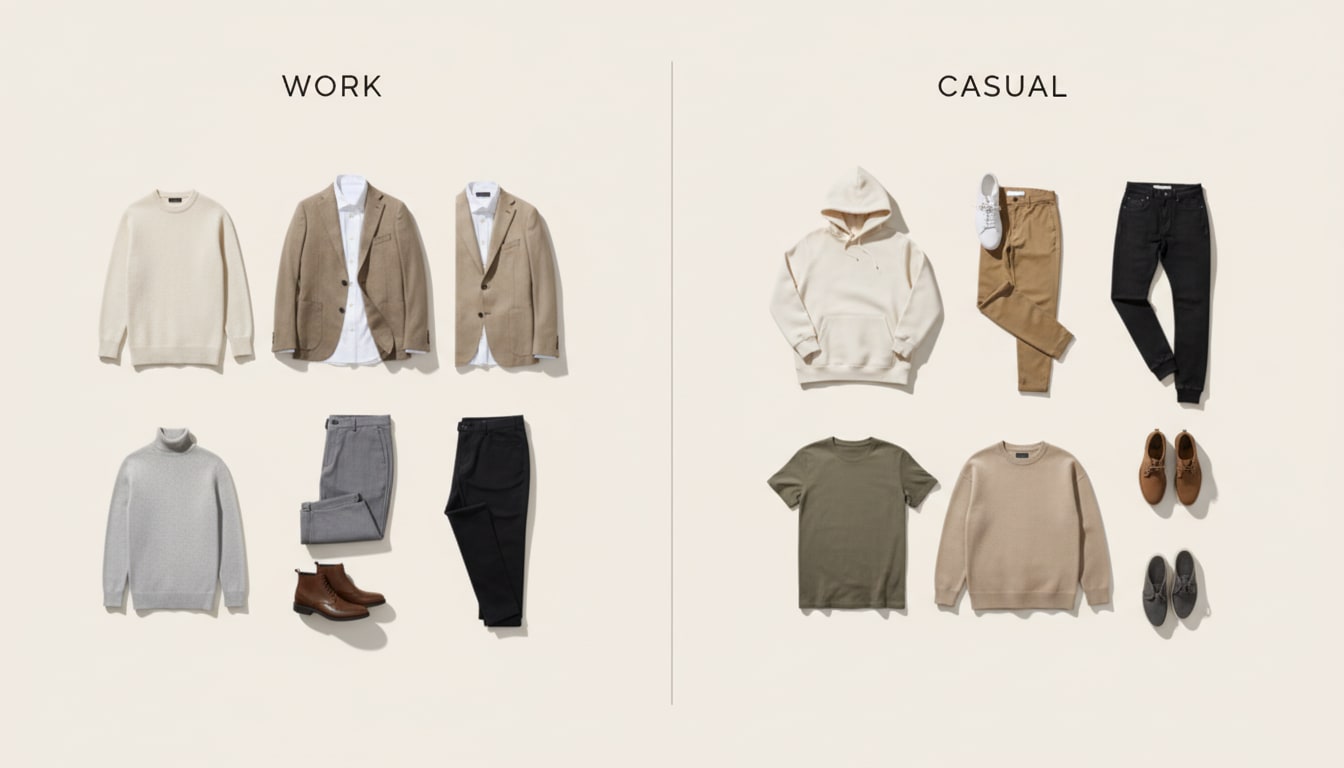
You can see which colors work together in your wardrobe by learning a few simple pairing rules and then checking them against your real pieces—not theory. When you see color combinations with your actual clothes, every outfit looks intentional. Here’s how to do it.
Why Color Pairing Matters
Colors that work together make an outfit feel cohesive; clashing or random pairings make it feel off even when the fit is fine. You don’t need a degree in color theory—you need neutral bases, complementary accents, and a way to try combos with what you own.
Basic Color Pairing Rules That Work
- Neutrals go with almost everything. Black, white, gray, navy, beige, and tan form a safe base. Pair any of these with each other or with one bold color.
- Analogous colors (next to each other on the color wheel, e.g. blue and green) feel harmonious. Good for a calm, put-together look.
- Complementary colors (opposite on the wheel, e.g. blue and orange) create contrast and pop. Use one as main and the other as accent so it doesn’t overwhelm.
- One statement color + neutrals. Let one piece (top, jacket, or accessory) be the color; keep the rest neutral so the outfit doesn’t fight itself.
How to See Color Combos With Your Own Clothes
- Group by color in your closet. Mentally or in a list: which pieces are neutral, which are warm, which are cool or bold.
- Try “this top + this bottom” on paper or in an app. The only way to know if your olive jacket works with your burgundy top is to see them together.
- Use a tool that shows color combinations with your pieces. Some apps let you build outfits and see how items look as a set—so you’re not guessing from memory.
DripCheck shows color combinations with your clothes so every outfit looks intentional.
 DripCheck outfit view—see how your pieces work together
Quick tips: See which colors work together
- Identify your neutrals (black, white, gray, navy, beige—pieces you wear most)
- Pick 2–3 accent colors you love and own; pair each with neutrals
- Test combos before you wear them (on paper or in an app)
- Rule: one statement color + neutrals so the outfit doesn't fight itself
What to avoid
- Mixing multiple bold colors without a neutral base—it often feels off. Let one piece be the color; keep the rest neutral.
- Guessing from memory. The only way to know if your olive jacket works with your burgundy top is to see them together—use a list, a photo, or an app. When you can see color combinations with your actual wardrobe—not just a color wheel—you make fewer “why does this feel wrong?” outfits and more that feel right.
Stop guessing which colors work together. DripCheck shows color combinations with your clothes so every outfit looks intentional.